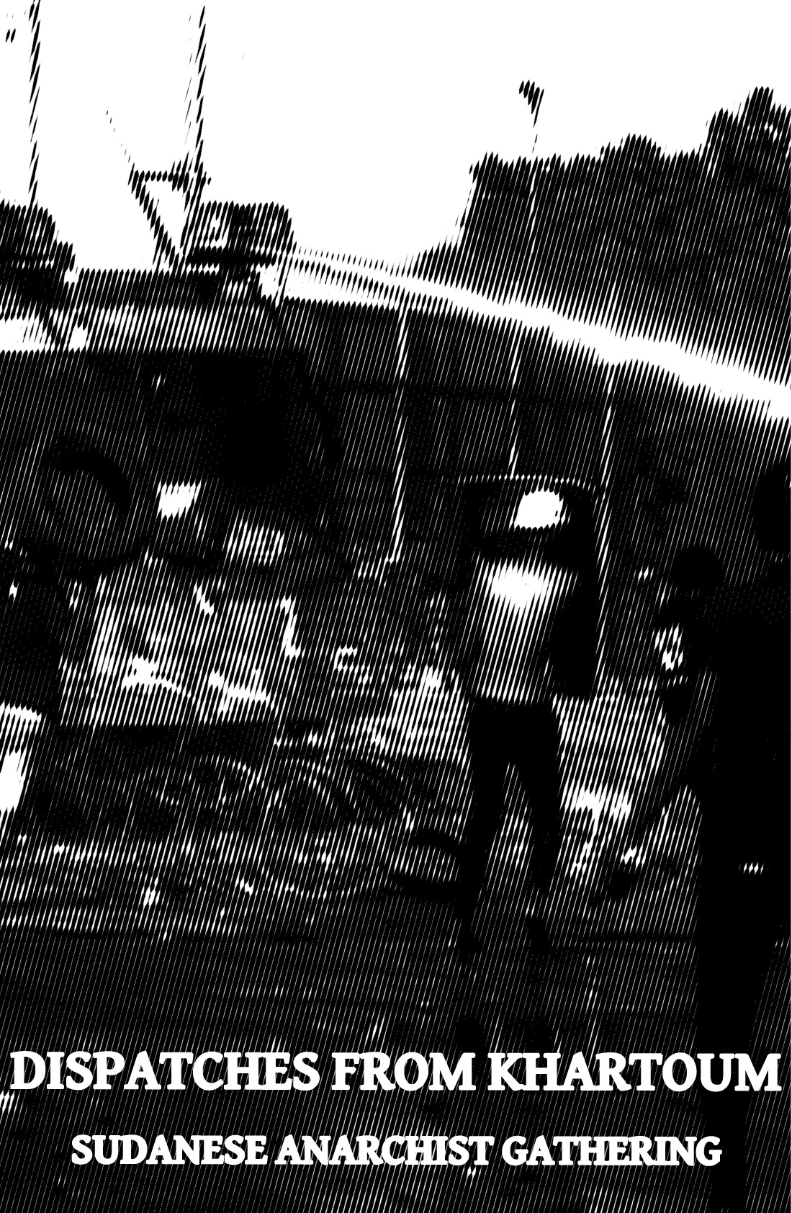
10 communiques from anarchists in Khatroum, Sudan sent to British anarchist magazine organise.
Avalible as a zine to read and print here. Also avalible on our Ko-fi

4th world Anarchists for a magazine as a community resource by us, for us.

We’re really grateful for how popular the first issue of the magazine has been! It kinda took us by surprise and made us scramble a little bit to get it out on time (Well, a whole season late) Thank you everyone who shared, printed, wrote, subscribed or bought the magazine!!
For this second issue, we’re looking for texts on Insurgency & Counter Insurgency.
Please try to have your proofread submissions in by April 1st, the magazine will be out on the 1st of May.
Essays, Reportbacks, Critiques, Poetry and Interviews* by Global Majority** anarchists and anti-authoritarians that present a critical look at ‘the social movement’ and anarchists & other radical’s relationship to it. Let’s talk about the repressive tactics the police, their defenders and their false critics have used against anarchists and others looking to do more than pose for photographs.
We’re tired of failing, we’re all sick of the pointless A-to-B marches in broad daylight that get us little more than photographed and kettled.
We’re bored of endless meetings that split hairs in four and overly waffle-filled analysis that benefits no one besides the person writing it.
We know there’s a better way to fight and that people are already at it. We just need to educate each other on how to turn the heat up.
*We can conduct these, over signal, over email or in person if given enough time, context and suggestions.
**Global Majority in this context refers to the people(s) who make up the majority of the world’s population, i.e. everyone but white people.
Submission Tips
Please send your articles as Plain Text inside of the email itself, having to re-format these from PDFs or Word/OpenOffice files takes time and slows down our emails.
Currently we are not accepting images as this would drive the print cost too high, sorry!
Our editorial crew’s first language is mostly English, but you can submit in other languages as long as we can get it translated.
fawnarchy@grrlz.net
fawnarchy@grrlz.net
fawnarchy@grrlz.net
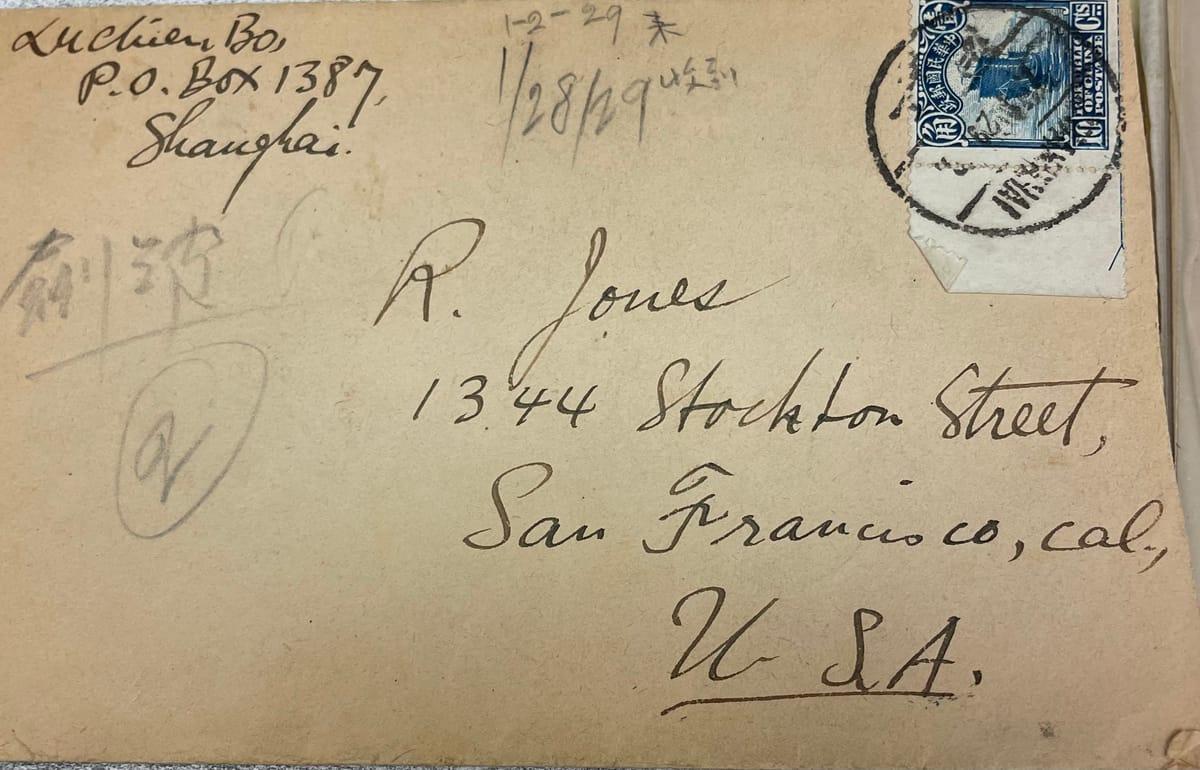
Kindly borrowed from;
“Anarchism is still the most beautiful ideal, and I think someday it will come,” wrote Lau Chung-Si (Ray Jones) from a small apartment in San Francisco. At the time he put these words to paper in 1974, he was a relic of another time. Jones was a Chinese man who, in 1909, immigrated to the United States and quickly became enamoured with the ideas of anarchism. He was involved in a collective of Chinese American anarchists in San Francisco named Pingsheh (Equality Society). He also attended meetings held by other anarchist organisations, as well as the Industrial Workers of the World (IWW). To date, not much has been written about the Chinese anarchists in America, but what has been written has focused on Ray Jones and the Equality Society. While acknowledging and continuing to use the Equality Society as a focal point, I am putting forward a preliminary analysis of the beliefs and praxis of Chinese American anarchists and their international connections as a part of a broader project of conceptualising Asian anarchism.
Information regarding Chinese American anarchists in America is fractured and spread far and wide. Most of the information analysed here was sourced from the Ray Jones Papers and the Him Mark Lai Collection at the UC Berkeley Ethnic Studies library. By cross-referencing of multiple sources, including first-hand accounts by the Chinese immigrants, newspapers distributed by the Chinese anarchist collectives, the writings of contemporaneous socialists and IWW members, and other miscellaneous materials, it is possible to reconstruct an image of the Chinese American anarchist movement, its involvement in the revolutionary struggle for anarchy, and their relationships to other political groups.
The Chinese American anarchist movement was born from the unique condition of being Asian immigrants who were exploited by American capitalists and unfairly excluded from unions by Marxists and reactionary trade unions such as the American Federation of Labor. It was the IWW’s acceptance of Chinese immigrants that ultimately led them to the philosophy of anarchism. These Chinese Americans deeply held anti-State and anti-capitalist principles and were in favour of anarchist communism, under which they engaged in the praxis of direct action. These Chinese American anarchists worked with groups within the larger anarchist movement on local, national, and international levels. Their adherence to anarchist principles and collaboration with other groups led to struggles locally with capitalist and State repression along with alienation from their homeland due to hostility from the Kuomintang (Chinese Nationalist Party) and the Chinese Communist Party.
Chinese immigrants failed in their attempts to join labour unions to combat the abysmal material conditions and exploitation that they faced under capitalism. A dogmatic belief in perverted formulation of Marx’s theories led many Marxists and like-minded socialists to exclude the Chinese immigrant proletariat from socialist labour unions and movements. In the 1900s, the Socialist Party of America was one of the largest socialist organisations in the United States. Their stance on Asian labourers was made clear by the “Summary of the Majority Report” at the 1910 Socialist Conference, which advocated for the:
‘…unconditional exclusion of Chinese, Japanese, Coreans [sic] and Hindus, not as races per se, not as peoples with definite physiological characteristics—but for the evident reason that these peoples occupy definite portions of the earth which are so far behind the general modern development of industry, psychologically as well as economically, that they constitute a drawback, an obstacle and menace to the progress of the most aggressive, militant and intelligent elements of our working class population.’
This is indicative of how many Marxists and adjacent socialists grouped Asian labourers as impediments to the revolution due to some perceived underdeveloped psychological and economic conditions. This line of thinking can largely be attributed to their understanding of Marx’s theory of historical materialism, which posits that a society needed to reach a certain stage of capitalist development before widespread class consciousness and revolutionary potential is possible. Since Marxists did not see Asian countries as having already reached that state of capitalism, they viewed the incorporation of Asian labourers as “fruitless and reactionary” and against the interest of the American working class as it would only hamper their revolutionary potential. However, the refusal to accept Asian labourers into unions cannot solely be attributed to racist revisions to Marx’s theories.
White supremacy was extremely prevalent in America which allowed those influenced by racism and xenophobia to add to the ongoing exclusion of Asian labourers. At the Socialist Conference, “Comrade Untermann … claimed that it was impossible to get the Asiatic laborers to understand the principles of labor organisation, much less of socialism.” This attitude demonstrates a belief of the racial inferiority of the Asian workers in comparison to their counterparts. While this supremacist view was common at the time, other socialists at the Socialist Conference challenged this thinking for being inherently racist — but to no avail. The anti-racist advocates were a minority at the Conference.
Despite anti-Asian biases being quite common amongst the American proletariat and socialist organisations, the heavily anarcho-syndicalist-adjacent IWW staunchly rejected any such sentiment as untrue and instead welcomed Asian labourers. The IWW’s view was articulated in the Industrial Union Bulletin’s coverage of The Proceedings of the Third Annual Convention’s “Resolution on Anti-Asiatic Persecution”:
‘In the past year several riots have occurred on the Pacific Coast directed against Asiatics on the ground that they are cheap labor … These Asiatics have, whenever an attempt has been made, shown their ability to organize, better their conditions and to stand true to their class … The interests of the working class are the same no matter what their race, creed and color and are diametrically opposed to the interests of the capitalist class, and … these outbreaks but serve to further divide the workers where they should be united, and therefore serve the interest of the master class, therefore, be it resolved … that we condemn the A.F. of L. [American Federation of Labor] as well as other so-called labor organizations who have in this respect aided the masters.’
The treatment of Chinese labourers as “cheap labor” by the bourgeoisie served as a means to cause conflict within the proletariat. By paying the Chinese little and engaging them primarily for physical labour, the bourgeoisie encouraged white workers to see them as inferior yet simultaneously as a threat to their economic position. This, in turn, caused division within the proletariat on racial lines which only benefited the capitalist class. The discrimination against Asian workers manifested in their exclusion from unions such as the American Federation of Labor and was countered in part by the IWW’s condemnation of labour unions that excluded Asian labourers.
The IWW accepted Chinese immigrants into its ranks and was “the only organisation that [had] ever done any organising among the Japanese and Chinese in [America].” The Asian labourers acted as other proletarians and had effectively organised for better conditions as described in the Industrial Union Bulletins (IUB):
‘None of the Japanese or Chinese who become members fail to realise their duty as to paying their dues and keeping in good standing. This cannot be said, truthfully, of all the “whites.” The Japanese and Chinese can be organised as rapidly as any other nationality. and when once pledged to stand with you, no fear or doubt needs to be entertained as to them, during labour trouble.’
The IUB emphasised that Asian labourers were just as effective and trustworthy as the white labourers, and were easily organised. Their actions showed that Marxist analysis of the revolutionary potential of the Asian immigrant proletariat was false and that the IWW’s recognition that the proletariat should be united by class against capital, regardless of race, was correct. Acceptance of Asian immigrants by the IWW led to the immigrants not only joining the IWW, but also adopting anarchist ideals in their own union called the Unionist Guild of America in order to focus on struggles more specific to their material conditions.
The principle at the core of anarchism is that all hierarchies are inherently oppressive and must be abolished. While the Chinese American anarchists fought for the deconstruction of all hierarchies, they placed an emphasis on critiquing the interconnected systemic oppression caused by the hierarchical structures of the State and capital. In their publication, Anarcho-Communist Monthly (ACM), they wrote:
‘[The private property system (Capitalism)] is when capitalists monopolise all production tools and production items, use the monetary system, and force us workers to be their wage slaves. We workers were forced by hunger and cold, so we sold our precious labour to them to do everything for them. We workers make everything in factories and cultivate various plants on farmland. However, everything we produce is owned by the capitalists.’
They viewed capitalism as a form of slavery under which they rented out their bodies in exchange for monetary compensation. Despite the workers labouring tirelessly to manufacture and farm goods, in actuality, they owned none of what they produced. Instead, their labour was stolen by the capitalist system under which both themselves and their labour were owned. However, besides capital, they acknowledged another hierarchical structure that contributed to the disparity between the proletariat and the bourgeoisie: the State.
The Chinese American anarchists acknowledged that the State was a tool wielded by the bourgeoisie to oppress the proletariat. In ACM, they wrote that:
‘Capitalists have occupied all production machines, not making them available to society, and depriving workers of their blood, sweat and lives … however, the government continues to defend the capitalists; if the workers have some demands on the capitalists, the government will immediately do its best to suppress our workers, intimidation, and even killing … the government must be overthrown and cannot be allowed to continue!’
Their analysis of society continued to critique the private ownership of the means of production by the bourgeoisie as it made the workers’ lives significantly worse. Furthermore, they added that the State always defended the interests of the ruling class. As the proletariat agitated through strikes and unionisation for better working conditions, the State would suppress the workers through tactics ranging anywhere from intimidation to full on massacres. Hence, the hierarchical structures of capital and the State were intertwined, and so, the Chinese American anarchists advocated the abolition of both.
The Chinese American anarchists desired to see a world antithetical to the current one with the State and capital replaced by anarchy and communism. In opposition to both the current system and their authoritarian counterparts on the left, they advocated for “free communism.” The Chinese anarchists described free communism as following the principle of “from each according to his ability, to each according to his needs” and how it could manifest in society:
‘That returns all property … to the common people, and the land to farmers. The villagers’ and peasants’ associations plan production, and the factories belong to the workers. The labor unions organized by the workers plan production, and distribution … Everyone works, everyone participates in all life decisions, there is no ruler, everyone freely enjoys the common products, and makes the best use of their talents and abilities.’
This conception of society aligns with the anarchist communism described by their primary inspiration, Pytor Kropotkin, as well as other classical anarchists while implementing elements of anarcho-syndicalism that were likely picked up from their work with the IWW. They wanted well-being for all, meaning that all needs would be fulfilled and work would be enjoyable. Additionally, these Chinese American anarchists wanted horizontal organisations in which each person had a say in the decisions made by their communities. This typically took the form of federated council structures that would elect a secretary to represent them for a limited time; these secretaries would advocate for their council’s position in larger district, provincial, and national gatherings. They believed that this could only be achieved through a society in which the proletariat owned the means of production with relationships characterised by free association.
As anarchism is a philosophy of praxis, the Chinese American anarchists’ means of abolishing hierarchies were intrinsically unified with their ends. They aimed for social revolution through the spreading of class consciousness and by using direct action to work toward their goals in a material way. The Equality Society published two newspapers: ACM and Equality. The purpose of these newspapers was to be the Chinese American anarchists’ “cry, [their] flag, and the sound of a bell that [aroused their] comrades” that “[promoted] anarchism and [recorded] news about the anarchist movement … [and] paid attention to the situation of Chinese workers in Europe and the United States.” The distribution of this literature was used to foster class consciousness within the Chinese immigrant proletariat by means of education. The content of a typical issue of either publication ranged from informative essays on the injustices of hierarchies of State and capital, to explanations of the ideas of anarchist communism, to critiques of Marxist-Leninist ideology, and to discussions on current events within their community and the broader anarchist movement. However, the “small monthly publication with black characters printed on white paper [was] not [their] main job, nor [was] it [their] only weapon.”
The primary form of direct action that the Equality Society took to fight against the State and capital was aiding unions and strikes. They distributed notices with support for the 1934 West Coast Waterfront Strike and the The National Dollar Stores Strike, among others. While the Chinese American anarchists critiqued the strikes on issues like “the capitalist collaboration with the union leaders” and were “not yet satisfied with the limits of their demands,” they were otherwise extremely supportive of these strikes, “viewing them as a once-in-a-lifetime opportunity for [the] Chinese workers to liberate themselves.” Additionally, they viewed strikes as a way to:
‘…spread [their] own ideals among the working class. In order to promote the class consciousness of workers, consolidate partial strikes into general strikes, and transform the general strike mechanism into an armed revolution of the working class against capitalism and the state! This is the solution!’
For them, strikes held a two-fold purpose, the first and more obvious one being to agitate for better working conditions and the second being for the further spread of class consciousness. The Chinese American anarchists viewed strikes in individual industries as a path to a general strike federated between all industries which would give rise to the proletariat’s revolutionary potential. The revolutionary potential could then be harnessed by the proletariat to enact a social revolution to dismantle the oppressive systems of the State and capital, which they viewed as the solution to oppression.
However, for any revolutionary movement to exist, there needs to be more than a single group working toward it. While the Equality Society was certainly the largest group of Chinese American anarchists, there was another notable collective based on the other coast. The New York-based Jue She (Awakeness Society) was established by:
‘…[t]he Chinese in New York [that] have always expressed sympathy for the anarchist communists. Recently … some of the hard-working elements among them established the Awakeness Society in order to study knowledge, increase their knowledge, explore the truth, and transform society.’
These Chinese American anarchists from New York performed essentially the same tasks as that of the Equality Society, their primary difference being geographic location. Interestingly, according to the historian Paul Avrich, “Its main figures were Yat Tone and Eddie Wong, who had come to New York from the Equality Group in San Francisco.” While there were other notable members, such as Gray Wu, who were not part of the Equality Society, the Chinese American anarchists in New York drew much of their inspiration and praxis from the experiences of the Equality Society in San Francisco. This established transcontinental connections between the Chinese American anarchists on both coasts, though their reach went well beyond just these two groups.
The Chinese American anarchists embraced proletarian unity and worked with a variety of different groups to achieve their revolutionary ends. The Equality Society most frequently worked with the IWW and local anarchist groups, primarily from immigrant communities. As noted in Equality:
‘The city’s Jewish, Russian, Italian, and Chinese anarchist comrades … picnic meeting on the 23rd of last month in this city … In addition to speeches, there were also music and ball games to add to the fun. It was also suggested by a Russian comrade that the four groups should unite in the future and hold a regular meeting every Saturday night to facilitate communication.’
The collaboration with other immigrant groups allowed for the Chinese American anarchists to create solidarity within their area through meetings. The purpose of these meetings was to foster bonds between the groups in order to build community rather than wholly being focused on their revolutionary project. Meanwhile, the Awakeness Society had a cooperative restaurant called Jade Mountain that “[raised] money for The Road to Freedom.” Connections with other anarchist groups allowed for solidarity and organisation in their communities. However, these networks spanned far beyond just locally.
The Chinese American anarchists were also connected to anarchists abroad. For example, they were in correspondence with Emma Goldman and the Equality publication was “co-organized by our comrades who live in Europe and the United States.” Additionally, the Equality Society was in frequent contact with the noted anarchist translator and writer Ba Jin and the mainland Chinese anarchists, as well as anarchists in Japan. Jones in particular corresponded with Ba Jin on current events in China and the publication of the Equality in Shanghai, as well. Meanwhile, analyses and overviews of the material conditions and revolutionary movements in China and Japan were frequently published in Equality and ACM, such as “Chinese Anarchism and Organizational Issues” and “The Anarcho-Syndicalist Movement in Japan.” Yet while these transnational connections allowed for communication and solidarity with the wider anarchist movement, it also came with consequences.
Chinese American anarchist activities in China led to oppression as their anti-hierarchical beliefs put them in opposition to both the Kuomintang and the Chinese Communist Party. The Chinese American anarchists described their position in Equality:
‘In the past, the Communist Party and the Kuomintang both wanted to help [people]. Now, although the Communist Party is still active everywhere and the Kuomintang is still in dictatorship … and the general public have nothing but resentment and resistance towards them.’
The Chinese populace viewed both the Kuomintang and Communist Party as having abandoned the people, instead prioritising their party’s political revolution to gain power. This led not only anarchists but also the general public to resent both parties instead of siding with either. In the ensuing clash with the Kuomintang, various anarchist operations were crushed by the party. Work on the aforementioned Shanghai-based edition of Equality was put to an end after “[their] distributing site [was] discovered by the Kuomintang.” The Chinese State decided to target these anarchists because they presented a threat to the status quo.
Chinese American anarchists’ principles also led them to trouble within the community of Chinese Americans in the United States. During the Sino-Japanese War, Ray Jones stuck to the anarchist principle of being anti-war as “the army, navy, air force … are all used to fight for the property of the country’s [bourgeoisie], and to … kill … the people.” As the anarchists deviated from the nationalistic tendencies harboured by their fellow immigrants, they faced consequences. Jones’ adherence to his beliefs led to him being physically assaulted at the San Francisco branch of Chinese Consolidated Benevolent Association due to his refusal to contribute to the war fund.
Due to the Chinese American anarchists’ spread of libertarian ideas that opposed State and capital, they faced repression at the hands of the United States government. In many cases there was collaboration between the State and capital as Chinatown “employers … turned to the headquarters of the persecution for assistance, which was, of course, cheerfully rendered.” In this, the Chinese American anarchists’ analysis of the State as a protector of bourgeoisie class interests was shown to be true. The actions against the Equality Society mostly took the form of police raids upon their headquarters and arrests of their members. In a 1928 issue of Chung Sai Yat Po, a local news publication, it was reported that:
Two Chinese people were arrested: they were brought to the precinct. The prosecution’s case against them accused them of illegally distributing leaflets … The Immigration Bureau sent translators to translate the “May Day Special Issue” and “Equality” pamphlets. Many of them were printed by the Equality Society … The group is suspected of spreading anarchism.
The United States government targeted the Chinese American anarchists for raising class consciousness through the distribution of literature. This was indicative that the United States government was somewhat threatened by the Chinese American anarchists’ efforts to educate the proletariat on the ideas of anarchism, pushing for an understanding that would endanger its monopoly of violence. Yet despite the arrests of the Equality Society’s members and confiscation of their literature by the police, they were “still determined to work hard on [their] work as usual.” The Chinese American anarchists were unyielding in their pursuit of the anarchist cause.
Though these hopeful revolutionaries made meaningful change and supported the proletariat to the best of their ability, the Chinese American anarchist movement died out following World War II. It was likely that this happened due to a combination of factors: continued repression by the State and capital, the Chinese immigrant proletariat embracing rising Maoist currents, and the general decline of the international anarchist movement.
The Chinese American anarchist movement was one that was uniquely formed from the exclusion of the Chinese immigrants from the wider American Left. Once they had adopted anarchism, they were steadfast in their anti-hierarchical beliefs, demonstrated through their attempts to move closer toward equality by the use of direct action. The international connections of the Chinese American anarchists allowed for them to communicate with the wider anarchist movement, although this sometimes resulted in additional state repression both in China and the United States. The work of the Chinese American anarchists remains relevant to this day, demonstrating that while the revolution may not come tomorrow, it is essential to continue grassroots efforts to organise and educate communities on the oppressive nature of hierarchies and how to combat them, both individually and collectively. Those who strive toward a more egalitarian world must not give up hope. In the words of Jones, “In this dark world … I seek brightness.”
Anarcho-Communist Monthly (San Francisco, CA). “告工人” [Tell Workers]. June 1934. Translated by Liao (April 2024). Carton 1, Folder 35, Him Mark Lai Papers, Asian American Studies Archive, Ethnic Studies Library, University of California, Berkeley. Berkeley, CA.
Anarcho-Communist Monthly (San Francisco, CA). “奴隸問題” [On the Slavery Problem]. August 1934. Translated by Liao (April 2024). Carton 1, Folder 35, Him Mark Lai Papers, Asian American Studies Archive, Ethnic Studies Library, University of California, Berkeley. Berkeley, CA.
Anarcho-Communist Monthly (San Francisco, CA). “紐約覺社成立” [New York Awakeness Society Established]. November 1934. Translated by Liao (April 2024). Carton 1, Folder 35, Him Mark Lai Papers, Asian American Studies Archive, Ethnic Studies Library, University of California, Berkeley. Berkeley, CA.
Anarcho-Communist Monthly (San Francisco, CA). “告民眾” [Inform the People]. November 1934. Translated by Liao (April 2024). Carton 1, Folder 35, Him Mark Lai Papers, Asian American Studies Archive, Ethnic Studies Library, University of California, Berkeley. Berkeley, CA.
Anarcho-Communist Monthly (San Francisco, CA). “奴隸問題” [On the Slavery Problem]. July 1934. Translated by Liao (April 2024). Carton 1, Folder 35, Him Mark Lai Papers, Asian American Studies Archive, Ethnic Studies Library, University of California, Berkeley. Berkeley, CA.
Anarcho-Communist Monthly (San Francisco, CA). “三藩市總罷工失敗的檢討” [Reflection on the Failure of the San Francisco General Strike]. September 1934. Translated by Liao (April 2024). Carton 1, Folder 35, Him Mark Lai Papers, Asian American Studies Archive, Ethnic Studies Library, University of California, Berkeley. Berkeley, CA.
Avrich, Paul. Anarchist Voices. Princeton, NJ: Princeton University Press, 1996. Accessed February 10, 2024.
Burgess, David. “Workers and Racial Hate.” Industrial Worker (Seattle, WA), June 4, 1910. Accessed February 10, 2024.
Chung Sai Yat Po (San Francisco, CA). “所聞之文字嫌疑,本埠警差前晚” [Rumors Heard, Local Police Dispatched Last Night]. March 23, 1928. East Asian Library, University of California, Berkeley. Berkeley, CA.
Equality. “敬告勞動民眾” [Warning to Working People]. n.d. Translated by Liao (April 2024). Box 1, Folder 18, Ray Jones Papers, Him Mark Lai Collection, Asian American Studies Archive, Ethnic Studies Library, University of California, Berkeley. Berkeley, CA.
Equality (San Francisco, CA). “我們的宣言” [Our Manifesto]. July 1927. Translated by Liao (April 2024). Carton 1, Folder 34, Him Mark Lai Papers, Asian American Studies Archive, Ethnic Studies Library, University of California, Berkeley. Berkeley, CA.
Equality (San Francisco, CA). “無政黨與共產黨不同” [The Difference Between Anarchism and Marxism]. n.d. Translated by Liao (April, 2024). Box 1, Folder 18, Ray Jones Papers, Him Mark Lai Collection, Asian American Studies Archive, Ethnic Studies Library, University of California, Berkeley. Berkeley, CA.
Equality (San Francisco, CA). “本刊啓事” [About this Publication]. July 1927. Translated by Liao (April, 2024). Carton 1, Folder 34, Him Mark Lai Papers, Asian American Studies Archive, Ethnic Studies Library, University of California, Berkeley. Berkeley, CA.
Equality (San Francisco, CA). “中國無政府主義與組織問題” [Chinese Anarchism and Organizational Issues]. August 1927. Translated by Liao (April, 2024). Carton 1, Folder 34, Him Mark Lai Papers, Asian American Studies Archive, Ethnic Studies Library, University of California, Berkeley. Berkeley, CA.
Equality (San Francisco, CA). “一個問題的問答” [Questions and Answers]. September 1929. Translated by Liao (April, 2024). Carton 1, Folder 34, Him Mark Lai Papers, Asian American Studies Archive, Ethnic Studies Library, University of California, Berkeley. Berkeley, CA.
Equality (San Francisco, CA). “小消息” [Some News]. November 1927. Translated by Liao (April, 2024). Carton 1, Folder 34, Him Mark Lai Papers, Asian American Studies Archive, Ethnic Studies Library, University of California, Berkeley. Berkeley, CA.
Equality (San Francisco, CA). “消息” [Notice]. July 1928. Translated by Liao (April, 2024). Carton 1, Folder 34, Him Mark Lai Papers, Asian American Studies Archive, Ethnic Studies Library, University of California, Berkeley. Berkeley, CA.
Equality (San Francisco, CA). “我們現在應該怎樣做呢?” [What Should We Do Now?]. July 1928. Translated by Liao (April, 2024). Carton 1, Folder 34, Him Mark Lai Papers, Asian American Studies Archive, Ethnic Studies Library, University of California, Berkeley. Berkeley, CA.
Industrial Union Bulletin (Chicago, IL). “Japanese and Chinese Exclusion or Industrial Organization, Which?” April 11, 1908, 3. Accessed February 10, 2024.
Industrial Union Bulletin (Chicago, IL). “Local Executive Board.” March 9, 1907, 3. Accessed February 10, 2024.
Industrial Union Bulletin (Chicago, IL). “Proceedings of the Third Annual Convention.” 1907, 400-08. Accessed January 11, 2024.
Industrial Union Bulletin (Chicago, IL). “Roumanian Workers’ Response.” July 13, 1907, 3. Accessed February 10, 2024.
The International Socialist Review (Chicago, IL), June 1910. Accessed January 11, 2024.
Jin, Ba. Letter to Ray Jones, “R. Jones Archives at Asian American Studies, University of California, Berkeley [Letters],” 1920-1950. Transcribed by Yamayuchi Mamory (October, 1995). Box 1, Folder 5, Ray Jones Papers, Him Mark Lai Collection, Asian American Studies Archive, Ethnic Studies Library, University of California, Berkeley. Berkeley, CA.
Jones, Ray. Interview by Him Mark Lai. San Francisco, CA. January 14, 1973. Box 121, Folder 34, Him Mark Lai Papers, Asian American Studies Archive, Ethnic Studies Library, University of California, Berkeley. Berkeley, CA.
The One Big Union Monthly (Chicago, IL). “The Chinese and the I.W.W.” March 1, 1919, 8.
Shuyao. History of the Meizhou Gongyi Tongmeng Zonghui (Unionist Guild of America). Translated by Him Mark Lai. San Francisco, CA: Chinese Historical Society of America, 2008. EPUB.
Kropotkin, Pytor. The Conquest of Bread. Paris, France: Tresse et Stock, 1892. Accessed April 11, 2024.
Wong, Jane Mee. “Retrieving an Asian American Anarchist tradition.” The Anarchist Library. Last modified March 4, 2008.
Zimmer, Kenyon. “‘No Right to Exist Anywhere on This Earth’: Anarchism in Crisis.” In Immigrants Against the State: Yiddish and Italian Anarchism in America, 166-205. Champaign, IL: University of Illinois Press, 2015. PDF.
Zimmer, Kenyon. “Positively Stateless: Marcus Graham, the Ferrero-Sallitto Case, and Anarchist Challenges to Race and Deportation.” In The Rising Tide of Color: Race, State Violence, and Radical Movements across the Pacific, edited by Moon-Ho Jung, 128-58. Seattle, WA: University of Washington Press, 2014. PDF.
Anarcho-Communist Monthly (San Francisco, CA). “誰是空想?” [Who’s Fantasizing]. September 1934. Translated by Liao (April 2024). Carton 1, Folder 35, Him Mark Lai Papers, Asian American Studies Archive, Ethnic Studies Library, University of California, Berkeley. Berkeley, CA.
Anarcho-Communist Monthly (San Francisco, CA). “辯證法的唯物史觀之批評” [Critique of Historical Materialism]. December 1934. Translated by Liao (April 2024). Carton 1, Folder 35, Him Mark Lai Papers, Asian American Studies Archive, Ethnic Studies Library, University of California, Berkeley. Berkeley, CA.
Anarcho-Communist Monthly (San Francisco, CA). “我的社會信仰” [My Social Beliefs]. July 1934. Translated by Liao (April 2024). Carton 1, Folder 35, Him Mark Lai Papers, Asian American Studies Archive, Ethnic Studies Library, University of California, Berkeley. Berkeley, CA.
Anarcho-Communist Monthly (San Francisco, CA). “無政府淺說” [A Brief Introduction to Anarchism]. August 1934. Translated by Liao (April 2024). Carton 1, Folder 35, Him Mark Lai Papers, Asian American Studies Archive, Ethnic Studies Library, University of California, Berkeley. Berkeley, CA.
Anarcho-Communist Monthly (San Francisco, CA). “無政府主義是什麼?” [What is Anarchism?]. November 1934. Translated by Liao (April 2024). Carton 1, Folder 35, Him Mark Lai Papers, Asian American Studies Archive, Ethnic Studies Library, University of California, Berkeley. Berkeley, CA.
Anarcho-Communist Monthly (San Francisco, CA). “評三藩市總同盟罷工” [Comment on the San Francisco General League Strike]. August 1934. Translated by Liao (April 2024). Carton 1, Folder 35, Him Mark Lai Papers, Asian American Studies Archive, Ethnic Studies Library, University of California, Berkeley. Berkeley, CA.
Anarcho-Communist Monthly (San Francisco, CA). “我們的綱領” [Our Program]. June 1934. Translated by Liao (April 2024). Carton 1, Folder 35, Him Mark Lai Papers, Asian American Studies Archive, Ethnic Studies Library, University of California, Berkeley. Berkeley, CA.
Anarcho-Communist Monthly (San Francisco, CA). “頭等走狗羅斯福嘯” [Roosevelt is a Lackey of the Bourgeoisie]. June 1934. Translated by Liao (April 2024). Carton 1, Folder 35, Him Mark Lai Papers, Asian American Studies Archive, Ethnic Studies Library, University of California, Berkeley. Berkeley, CA.
Anarcho-Communist Monthly (San Francisco, CA). “誤解?中傷隨感” [Misunderstanding or Slander?]. July 1934. Translated by Liao (April 2024). Carton 1, Folder 35, Him Mark Lai Papers, Asian American Studies Archive, Ethnic Studies Library, University of California, Berkeley. Berkeley, CA.
Anarcho-Communist Monthly (San Francisco, CA). “給我們工作做!” [Give Us Work]. December 1934. Translated by Liao (April 2024). Carton 1, Folder 35, Him Mark Lai Papers, Asian American Studies Archive, Ethnic Studies Library, University of California, Berkeley. Berkeley, CA.
Anarcho-Communist Monthly (San Francisco, CA). “無政府淺說” [A Brief Introduction to Anarchism]. September 1934. Translated by Liao (April 2024). Carton 1, Folder 35, Him Mark Lai Papers, Asian American Studies Archive, Ethnic Studies Library, University of California, Berkeley. Berkeley, CA.
Anarcho-Communist Monthly (San Francisco, CA). “無政府主義是什麼?” [What is Anarchism?]. December 1934. Translated by Liao (April 2024). Carton 1, Folder 35, Him Mark Lai Papers, Asian American Studies Archive, Ethnic Studies Library, University of California, Berkeley. Berkeley, CA.
Anarcho-Communist Monthly (San Francisco, CA). “日本的無政府工阁主義運動 “ [The Anarcho-Syndicalist Movement in Japan]. November 1934. Translated by Liao (April 2024). Carton 1, Folder 35, Him Mark Lai Papers, Asian American Studies Archive, Ethnic Studies Library, University of California, Berkeley. Berkeley, CA.
Anarcho-Communist Monthly (San Francisco, CA). “在十字路” [At the Crossroads]. November 1934. Translated by Liao (April 2024). Carton 1, Folder 35, Him Mark Lai Papers, Asian American Studies Archive, Ethnic Studies Library, University of California, Berkeley. Berkeley, CA.
Anarcho-Communist Monthly (San Francisco, CA). “斥駁共產黨” [Refute of the Communist Party]. September 1934. Translated by Liao (April 2024). Carton 1, Folder 35, Him Mark Lai Papers, Asian American Studies Archive, Ethnic Studies Library, University of California, Berkeley. Berkeley, CA.
Anarcho-Communist Monthly (San Francisco, CA). “無政府淺說” [A Brief Introduction to Anarchism]. June 1934. Translated by Liao (April 2024). Carton 1, Folder 35, Him Mark Lai Papers, Asian American Studies Archive, Ethnic Studies Library, University of California, Berkeley. Berkeley, CA.
Anarcho-Communist Monthly (San Francisco, CA). “無政府淺說” [A Brief Introduction to Anarchism]. November 1934. Translated by Liao (April 2024). Carton 1, Folder 35, Him Mark Lai Papers, Asian American Studies Archive, Ethnic Studies Library, University of California, Berkeley. Berkeley, CA.
Anarcho-Communist Monthly (San Francisco, CA). “我們在那裏” [We Are There]. November 1934. Translated by Liao (April 2024). Carton 1, Folder 35, Him Mark Lai Papers, Asian American Studies Archive, Ethnic Studies Library, University of California, Berkeley. Berkeley, CA.
Anarcho-Communist Monthly (San Francisco, CA). “無政府淺說” [A Brief Introduction to Anarchism]. July 1934. Translated by Liao (April 2024). Carton 1, Folder 35, Him Mark Lai Papers, Asian American Studies Archive, Ethnic Studies Library, University of California, Berkeley. Berkeley, CA.
Anarcho-Communist Monthly (San Francisco, CA). “所謂國民革命” [The So-Called National Revolution]. June 1934. Translated by Liao (April 2024). Carton 1, Folder 35, Him Mark Lai Papers, Asian American Studies Archive, Ethnic Studies Library, University of California, Berkeley. Berkeley, CA.
Anarcho-Communist Monthly (San Francisco, CA). “共產黨說鬼話” [The Communist Party Speaks Nonsense]. July 1934. Translated by Liao (April 2024). Carton 1, Folder 35, Him Mark Lai Papers, Asian American Studies Archive, Ethnic Studies Library, University of California, Berkeley. Berkeley, CA.
Anarcho-Communist Monthly (San Francisco, CA). “當心罷!走狗們” [Watch Out, Capitalist Lackeys]. June 1934. Translated by Liao (April 2024). Carton 1, Folder 35, Him Mark Lai Papers, Asian American Studies Archive, Ethnic Studies Library, University of California, Berkeley. Berkeley, CA.
Anarcho-Communist Monthly (San Francisco, CA). “斥駁共產黨” [Refute of the Communist Party]. August 1934. Translated by Liao (April 2024). Carton 1, Folder 35, Him Mark Lai Papers, Asian American Studies Archive, Ethnic Studies Library, University of California, Berkeley. Berkeley, CA.
Anarcho-Communist Monthly (San Francisco, CA). “無政府淺說” [A Brief Introduction to Anarchism]. December 1934. Translated by Liao (April 2024). Carton 1, Folder 35, Him Mark Lai Papers, Asian American Studies Archive, Ethnic Studies Library, University of California, Berkeley. Berkeley, CA.
Anarcho-Communist Monthly (San Francisco, CA). “我們的戰暑” [We Are Fighting]. June 1934. Translated by Liao (April 2024). Carton 1, Folder 35, Him Mark Lai Papers, Asian American Studies Archive, Ethnic Studies Library, University of California, Berkeley. Berkeley, CA.
Equality. “怎樣認識報紙的真面目” [How to Understand the True Meaning of Newspapers]. n.d. Translated by Liao (April 2024). Box 1, Folder 18, Ray Jones Papers, Him Mark Lai Collection, Asian American Studies Archive, Ethnic Studies Library, University of California, Berkeley. Berkeley, CA.
Equality. “告勞動民眾” [Inform the Workers]. n.d. Translated by Liao (April 2024). Box 1, Folder 18, Ray Jones Papers, Him Mark Lai Collection, Asian American Studies Archive, Ethnic Studies Library, University of California, Berkeley. Berkeley, CA.
Equality (San Francisco, CA). “改造的時到橫了嗎?” [Is It Time For Revolution?]. March 1929. Translated by Liao (April, 2024). Carton 1, Folder 34, Him Mark Lai Papers, Asian American Studies Archive, Ethnic Studies Library, University of California, Berkeley. Berkeley, CA.
Equality (San Francisco, CA). “我們的閒話” [Our Talk]. September 1929. Translated by Liao (April, 2024). Carton 1, Folder 34, Him Mark Lai Papers, Asian American Studies Archive, Ethnic Studies Library, University of California, Berkeley. Berkeley, CA.
Equality (San Francisco, CA). “人” [People]. August 1927. Translated by Liao (April, 2024). Carton 1, Folder 34, Him Mark Lai Papers, Asian American Studies Archive, Ethnic Studies Library, University of California, Berkeley. Berkeley, CA.
Equality (San Francisco, CA). “復歸於行動的無政府主義” [Anarchism Returned to Action]. September 1929. Translated by Liao (April, 2024). Carton 1, Folder 34, Him Mark Lai Papers, Asian American Studies Archive, Ethnic Studies Library, University of California, Berkeley. Berkeley, CA.
Equality (San Francisco, CA). “小消息” [Some News]. July 1927. Translated by Liao (April, 2024). Carton 1, Folder 34, Him Mark Lai Papers, Asian American Studies Archive, Ethnic Studies Library, University of California, Berkeley. Berkeley, CA.
Equality (San Francisco, CA). “日本無政府主義運動略史” [A Brief History of the Japanese Anarchist Movement]. July 1927. Translated by Liao (April, 2024). Carton 1, Folder 34, Him Mark Lai Papers, Asian American Studies Archive, Ethnic Studies Library, University of California, Berkeley. Berkeley, CA.
Equality (San Francisco, CA). “我們這姿這不公平的社會麼?” [Is Our Society Such an Unfair One?]. July 1927. Translated by Liao (April, 2024). Carton 1, Folder 34, Him Mark Lai Papers, Asian American Studies Archive, Ethnic Studies Library, University of California, Berkeley. Berkeley, CA.
Equality (San Francisco, CA). “平等” [Equality]. July 1927. Translated by Liao (April, 2024). Carton 1, Folder 34, Him Mark Lai Papers, Asian American Studies Archive, Ethnic Studies Library, University of California, Berkeley. Berkeley, CA.
Equality (San Francisco, CA). “華工解放的機會到了” [The Opportunity to Liberate Chinese Workers Has Arrived]. n.d. Translated by Liao (April, 2024). Box 1, Folder 18, Ray Jones Papers, Him Mark Lai Collection, Asian American Studies Archive, Ethnic Studies Library, University of California, Berkeley. Berkeley, CA.
Equality (San Francisco, CA). “小消息” [Some News]. August 1927. Translated by Liao (April, 2024). Carton 1, Folder 34, Him Mark Lai Papers, Asian American Studies Archive, Ethnic Studies Library, University of California, Berkeley. Berkeley, CA.
Equality (San Francisco, CA). “日本無政府主義運動略史(續)” [A Brief History of the Japanese Anarchist Movement]. August 1927. Translated by Liao (April, 2024). Carton 1, Folder 34, Him Mark Lai Papers, Asian American Studies Archive, Ethnic Studies Library, University of California, Berkeley. Berkeley, CA.
The Freedom Press. Letter to Ray Jones, March 25, 1964. Box 1, Folder 5, Ray Jones Papers, Him Mark Lai Collection, Asian American Studies Archive, Ethnic Studies Library, University of California, Berkeley. Berkeley, CA.
Industrial Union Bulletin (Chicago, IL). “A Field for Organizers in the Northwest.” May 23, 1908, 1. Accessed February 10, 2024.
Industrial Union Bulletin (Chicago, IL). “The Yellow Peril.” May 15, 1913, 2. Accessed April 5, 2024.
Kung Sing (San Francisco, CA), March 1924.
Kung Sing (San Francisco, CA), April 1924.
Lee, Olden, and George Lau. Interview by Him Mark Lai, Marilyn Koon, and Sam Ahtye. San Francisco, CA. January 9, 1973. Box 121, Him Mark Lai Papers, Asian American Studies Archive, Ethnic Studies Library, University of California, Berkeley. Berkeley, CA.
Christiansen, Jonathan A. “‘We Are All Leaders: Anarchism and the Narrative of the Industrial Workers of the World.” Industrial Workers of the World. Last modified September 1, 2009. Accessed April 3, 2024.
Dirlik, Arif. Anarchism in the Chinese Revolution. Berkeley, CA: University of California Press, 1991. Accessed April 11, 2024.
Foner, Philip S. Industrial Workers of the World. Vol. 4 of History of the Labor Movement in the United States. New York City, NY: International Publishers, 1977.
Kropotkin, Pytor. Mutual Aid: A Factor in Evolution. New York City, NY: McClure Phillips & Company, 1902. Accessed April 11, 2024.
Kropotkin, Pytor. “Syndicalism and Anarchism.” Anarchist Union of North Germany (Germany), 1908.
Lai, Him Mark. “A Historical Survey of the Chinese Left in America.” Counterpoint: Perspectives on Asian America, 1976, 63-80. Accessed February 10, 2024.
Lai, Him Mark. “In Unity There Is Strength: Chinese Workers’ Fight For a Better Life.” East/West (San Francisco, CA), May 1, 1974, 6-8. Accessed January 11, 2024.
Mitch. “Chinese Anarchists in the 1920’s USA – the Equality Society.” Anarcho-Syndicalist Review (Philadelphia, PA), 2006. Accessed January 11, 2024.
Rocks, Morgan. “Beyond the bounds of revolutions : Chinese in transnational anarchist networks from the 1920s to the 1950s.” PhD diss., University of British Columbia, 2020. Accessed January 11, 2024.
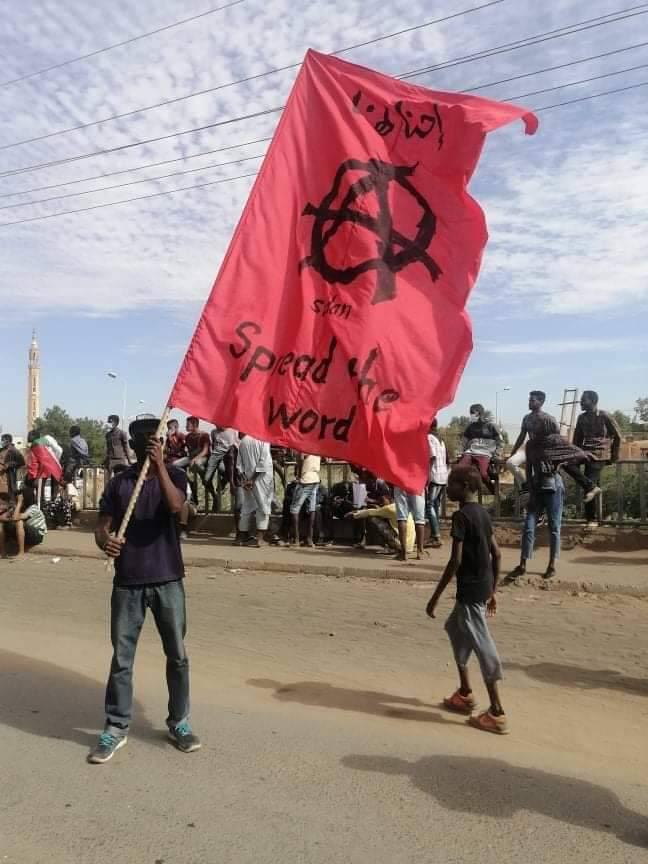
The Sudanese Anarchist Gathering formed in 2018 during the December Revolution. They are a group of young men and women that met during demonstrations and in universities despite political repression against student organising.
We have prepared a zine of texts by sudanese anarchists which can be downloaded for free or ordered from our ko-fi, with proceeds being donated to the Sudanese Anarchsit Gathering.
If you are an org or group of friends who want to put on an event to support the Sudanese Anarchist Gathering or other Sudanese people resisting war and genocide, get in touch and we can send you a box of the zine for free.
Below is a post we are sharing from the CNT-AIT, cut and paste from a repost by Freedom Press
Translated from Actualité de l’Anarchosyndicalisme.
Content warning: contains accounts of war crimes, including rape.
In the previous issue of Anarchosyndicalisme, the CNT-AIT echoed the call for solidarity from anarchists in Sudan.
Since a terrible war broke out on 15 April 2023 between two military factions – the Rapid Support Forces (or Janjaweed militias) against the official army – civilians have been living in a climate of “pure terror” because of a “ruthless and senseless conflict”, denounced by the UN with general indifference. At least 15,000 people have died, and more than 26,000 have been injured, but these figures are certainly underestimates.
There are 11 million internally displaced people, 1.8 million people in exile, and 18 million people at acute risk of starvation. 8 million workers have lost their jobs and their income. 70% of areas no longer have water or electricity, 75% of hospitals have been destroyed, 19 million students have stopped studying, 600 industrial plants have been destroyed and looted, as have 110 banks, 65% of agriculture has been destroyed, 80% of inputs (fertilisers, pesticides, agricultural machinery and harvesters) in the Geziera irrigated area – the largest in the world – have been looted and destroyed, etc.
The media and activist silence surrounding Sudan is allowing soldiers on both sides to commit genocide with impunity. The conflict between the two clans has many components: ethnic, with its trail of reciprocal genocides (according to the UN); “imperialist”, because each of the two opposing groups is supported by various foreign powers that covet Sudan for its natural resources and its strategic location. But above all, it is a “counter-revolutionary” war. By putting the country to fire and blood, it has crushed the hopes of the civil and democratic revolution. And drove many of the revolution’s activists into exile. By completely destabilising the country, this war has enabled the leaders of the former regime to remain in power without being tried for the crimes they committed over decades (during the military dictatorship and then the coup d’état).
The Revolutionary Committees, in which our anarchist companions participate, are trying to maintain their activity, but this is becoming increasingly difficult with the escalation of violence by the two military factions.
Following the appeal for solidarity, we received more than 1,200 euros (including 200 euros from the companions of the Kurdish-language anarchist forum, KAF), which we were able to pass on to our Sudanese companions. This solidarity enabled them to organise humanitarian distributions of blankets, hygiene products (sanitary pads, soap, toothpaste) and infant milk. A reception area for children was organised, with drawing materials and elementary classes, giving the children a chance to escape the madness of war.
But today, the situation is becoming impossible. The violence of the military groups is unleashed. The Janjaweed militias are behaving like barbarians towards civilians. They murdered our companion Sarah after raping her. For their part, the soldiers are arresting and torturing revolutionaries, accusing them of being allied with the Janjaweed. Our companions urgently need to seek shelter in neighbouring countries. We are relaying their desperate appeal to the international anarchist movement.
If you would like to make a contribution, please send cheques made payable to CNT AIT to CNT-AIT 7 rue St Rémésy 31000 TOULOUSE, or via PayPal: https://www.paypal.com/paypalme/cntait1
Greetings from the revolutionary comrades of Sudan to all the anarchists of the world!
After the regime attempted to destroy and dismantle the glorious December Revolution, the outbreak of the 15 April war caused the displacement of 15 million Sudanese, the suffering of the entire population, the onset of famine and the deterioration of the humanitarian situation. And now the Islamic brigades have launched campaigns targeting revolutionaries and have made numerous arrests and surrenders.
The group of Sudanese anarchists invites you to show solidarity with it so that it can continue its great liberation activity and take it up again, including from abroad.
We would like you to help us get some of our companions out of the country, where they are threatened with arbitrary arrest.
Down with the fascist military regime, down with the Janjaweed brigades!
No to the arrest of revolutionaries, No to the torture of revolutionaries!
Long live the Free Revolution of December!
=======
WHAT CAN YOU DO IN SOLIDARITY WITH THE PEOPLE OF SUDAN?
You can do a lot, individually or with a few people. The important thing is to talk about Sudan so that as many people as possible are informed about what is happening there!
1) Keep up to date with the situation in Sudan via the SudfaMedia [French].
2) Send messages of solidarity to contact@cnt-ait.info, and we’ll pass them on to our fellow anarchists in Sudan.
3) Talk on social media to your family, your friends, and your work colleagues about Sudan, its revolution and the abomination of the army, the rapid forces and the Islamists. A 4-page explanation of the situation can be downloaded here [in French].
4) Organise leaflet distributions [French], press tables, solidarity collections and events in solidarity with the Sudanese people and against the massacres.
======
Military in barracks and militias (janjawid) must disband
No negotiation, no partnership, no haggling
Against war
Power is the power of the people
Peace, freedom and solidarity
Let us not abandon the anarchists of Sudan! Solidarity and mutual support make us stronger!
Shola Von Reinhold – LOTE
A masterclass in execution of anarchist literature in form and politic. About the archive, doing crimes, & the extraction of Black radical thought from Black trans women
Michael Rolph Troulil – Stirring the Pot of Haitian History
A history of the Haitian revolution and counterrevolution
Hashi Kenneth Tafira – Black Nationalist Thought In South Africa
How Black nationalist thought came to be and transformed thru tha times
Diana Block – Clandestine Occupations: An Imaginary History
Fiction about a woman who goes underground in america during the 70s – about those guerilla groups that popped up at this time
Darcus Howe – From Bobby to Babylon: Blacks & the British Police
Produced in the aftermath of the uprisings that shook Britain in 1981 and how they arose out of systematic racism, poverty, unemployment and rage against the police.
Mohammed El-Kurd – Perfect Victims: and the Politics of Appeal
Hybachi LeMar – The Ghetto Bred Anarchist
Felwine Sarr – Afroutopia
Orisanmi Burton – Tip Of The Spear
20/12/2024
On the 27th November dozens of riot police carried out dawn raids on the Kurdish Community Centre (KCC) in Harringey, North London, and several home addresses across the capital.
A number of anti-genocide activists from the Kurdish refugee community were arrested under terrorism charges, several more comrades were arrested the same day on protest related charges. A wave of protests, an occupation and hunger strikes followed until KCC was returned to the community. Under constant pressure the return took place over a week earlier then planned, despite what appears to have been a multi-million pound policing operation.
The dawn raids came just weeks after Turkey’s minister of foreign affairs Hakan Fidan, a leading fascist in Erdogan’s AKP party, met with Britain’s foreign secretary David Lammy, also the local MP for Harringey. This attack on the Kurdish community seems to clearly be part of agreed negotiations, in exchange for Turkey’s continued support as a NATO member for western Imperialism, in particular Israeli aggression.
These raids must also be seen in the geopolitical context as part of the handover negotiations, from Bashar al-Assad’s brutal dictatorship, to a coalition made up mostly of Jihadists, including former ISIS and Al-Qaida (now known in Syria as HTS) fighters, and Turkish funded and trained militias. These militias have been taking a passive approach to Israeli aggression in the Middle East, and attacks on Syrian land, earning them support from the Western ruling class despite their political ideology.
Today (20/12/24) 6 of the Kurdish activists taken in the dawn raids had a court hearing at the old Bailey. A comrade who sometimes writes for Muntjac has written the following report from todays trial:
The 6 people charged with terror offences have been bailed for a trial date in January 2026.
In the meantime they are released on tag under house arrest and with draconian bail conditions. They have to report to the police station between 12 and 2 daily, making it hard for them to work and study, and bail conditions barring them from the area around KCC means they can’t use the Piccadilly line which goes underneath KCC or the overground line going next to it.
Kurdish activists have been asking supporters to brainstorm ways in which our networks can keep supporting the Kurdish community through this. They’ve said probably the way people can support them the most is by extending revolutionary social changes from Rojava into our countries through local neighbourhood direct democracy, environmentalism and women led liberation.
It must surely be assumed that if these people genuinely were directing a “terrorist organisation”, posing an immediate threat to life, the system would be locking them up straight away and not bailing them until 2026 under house arrest. This gives us time to turn things around, the Turkish state will be ramping up pressure on the British government to deliver long sentences. Collectively we can put greater pressure on UK politicians to put a stop to these show trials and stop supporting the genocide being waged against the only real democracy in the Middle East.
If these freedom fighters are to be given 10 year sentences, this will represent yet another grave injustice in British colonialism’s long and shameful history. What can be certain is that like every other empire before it, this systematic corruption will not be continuing indefinitely.
http://www.sojournertruth.net/interview1.html
Extracted from^
The political struggle for working class emancipation would be led by a political party of intellectuals drawn from the middle classes with a handful of advanced workers in tow. Once in government the leadership would provide proper welfare, organize the workers to produce more in order to meet the costs, the workers to be motivated either by incentives, the moral whip or Siberia. The surplus goes towards projects sanctioned by the leadership and the massive bureaucracy which hangs over to corrupt the new. Surplus for guns, travelling expenses for bureaucrats to beg loans abroad. From time to time, with less regularity as the years go by, the working class would be called to large gatherings then sent home after being told of the latest in the development plan to which they must shout their assent. All this is spiced with revolutionary slogans All independent attempts at working class and peasant organization are to be squashed with a ferocity which surpasses that meted out by previous colonial masters.
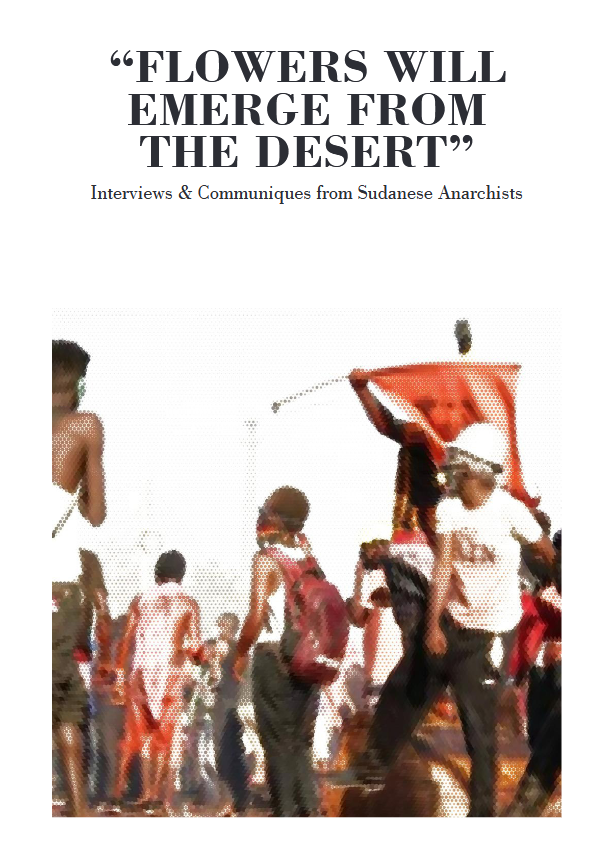
A collection of interviews and writings by anarchists in Sudan.
Also avalible in our shop; https://ko-fi.com/s/02d9e93e68 [Proceeds donated to the Sudanese Anarchist Gathering]
Flowers Sudan-Print Flowers Sudan Read
If you are an org or group of friends who want to put on an event to support the Sudanese Anarchist Gathering or other Sudanese people resisting war and genocide, get in touch and we can send you a box of the zine for free.
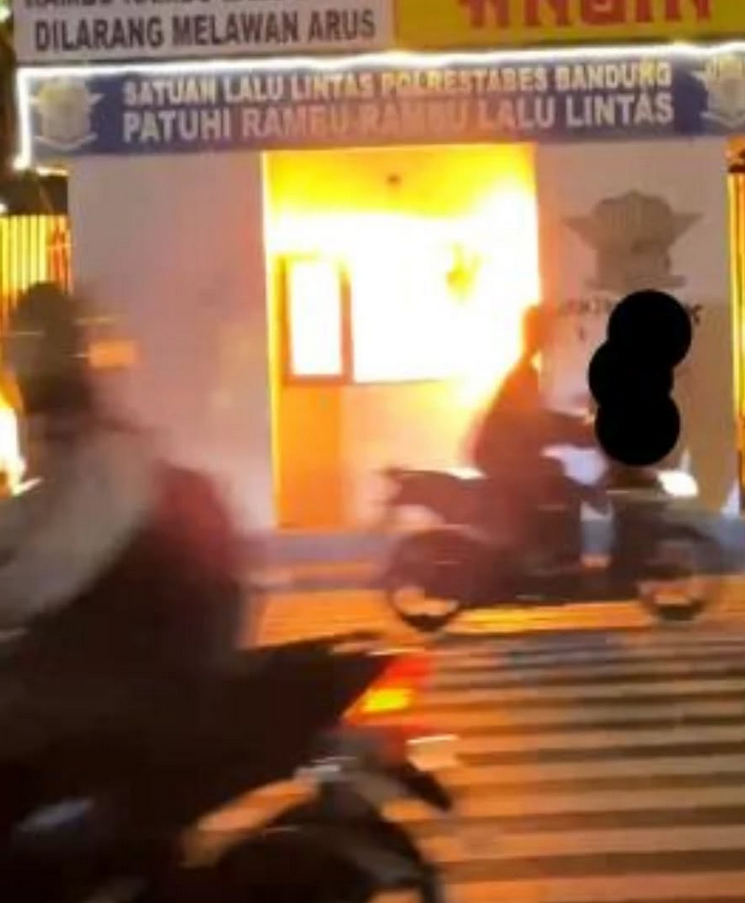
DITERIMA DARI SITUS anarchistnews org
ACTION CLAIM FOR NIKOS ROMANOS AND SIDIQ/AND ALL THOSE WHO WERE KILLED BY COPS/BANDUNG
We claim that the attack and arson of a police post in Bandung, West Java on December 13, 2024 coincided with World Anti-Police Day. This attack and arson is in solidarity with our imprisoned comrade Nikos Romanos, as well as Sidiq and all imprisoned anarchists. This attack is also in solidarity with the victims of police brutality who have lost their lives all over the world and in this fascist country. Police agencies will never disintegrate on their own just like the state, they must be destroyed!
Until all are free!
Until all prisons are destroyed!
Fire on the prisons!
Free Association of Autonomous Fire
______________________________________________________
Kita mengklaim aksi penyerangan serta pembakaran terhadap pos polisi di daerah Bandung, Jawa Barat pada tanggal 13 desember 2024 bertepatan dengan hari anti polisi sedunia. Tak lupa penyerangan dan pembakaran ini adalah bentuk solidaritas untuk kawan kami Nikos Romanos yg terpenjara, juga Sidiq dan semua anarkis yg terpenjara. Penyerangan ini juga ditujukan untuk solidaritas kepada korban kebrutalan polisi yg telah memakan korban jiwa di seluruh dunia dan di negara fasis ini. Badan kepolisian tidak akan pernah hancur dengan sendirinya sama seperti negara, mereka harus dihancurkan!
Sampai semua bebas!
Sampai semua penjara hancur!
Api ke penjara!
Free Association of Autonomous Fire