Skip to content

Muntjac Magazine

4th world Anarchists for a magazine as a community resource by us, for us.

  • Magazine
  • Recent Posts
  • Articles
  • Submissions
  • Zines & Merch
  • Anarchism In Sudan Archive
  • About & FAQ
  • Current Issue

Month: December 2024

Anon – Freedom fighters North London & Worldwide

Posted on 20/12/2024 - 26/12/2024 by muntjac

20/12/2024

On the 27th November dozens of riot police carried out dawn raids on the Kurdish Community Centre (KCC) in Harringey, North London, and several home addresses across the capital.

A number of anti-genocide activists from the Kurdish refugee community were arrested under terrorism charges, several more comrades were arrested the same day on protest related charges. A wave of protests, an occupation and hunger strikes followed until KCC was returned to the community. Under constant pressure the return took place over a week earlier then planned, despite what appears to have been a multi-million pound policing operation.

The dawn raids came just weeks after Turkey’s minister of foreign affairs Hakan Fidan, a leading fascist in Erdogan’s AKP party, met with Britain’s foreign secretary David Lammy, also the local MP for Harringey. This attack on the Kurdish community seems to clearly be part of agreed negotiations, in exchange for Turkey’s continued support as a NATO member for western Imperialism, in particular Israeli aggression.

These raids must also be seen in the geopolitical context as part of the handover negotiations, from Bashar al-Assad’s brutal dictatorship, to a coalition made up mostly of Jihadists, including former ISIS and Al-Qaida (now known in Syria as HTS) fighters, and Turkish funded and trained militias. These militias have been taking a passive approach to Israeli aggression in the Middle East, and attacks on Syrian land, earning them support from the Western ruling class despite their political ideology.

Today (20/12/24) 6 of the Kurdish activists taken in the dawn raids had a court hearing at the old Bailey. A comrade who sometimes writes for Muntjac has written the following report from todays trial:

The 6 people charged with terror offences have been bailed for a trial date in January 2026.

In the meantime they are released on tag under house arrest and with draconian bail conditions. They have to report to the police station between 12 and 2 daily, making it hard for them to work and study, and bail conditions barring them from the area around KCC means they can’t use the Piccadilly line which goes underneath KCC or the overground line going next to it.

Kurdish activists have been asking supporters to brainstorm ways in which our networks can keep supporting the Kurdish community through this. They’ve said probably the way people can support them the most is by extending revolutionary social changes from Rojava into our countries through local neighbourhood direct democracy, environmentalism and women led liberation.

It must surely be assumed that if these people genuinely were directing a “terrorist organisation”, posing an immediate threat to life, the system would be locking them up straight away and not bailing them until 2026 under house arrest. This gives us time to turn things around, the Turkish state will be ramping up pressure on the British government to deliver long sentences. Collectively we can put greater pressure on UK politicians to put a stop to these show trials and stop supporting the genocide being waged against the only real democracy in the Middle East.

If these freedom fighters are to be given 10 year sentences, this will represent yet another grave injustice in British colonialism’s long and shameful history. What can be certain is that like every other empire before it, this systematic corruption will not be continuing indefinitely.

Darcus Howe on ‘third world “socialism”

Posted on 18/12/2024 by muntjac

http://www.sojournertruth.net/interview1.html

Extracted from^

The political struggle for working class emancipation would be led by a political party of intellectuals drawn from the middle classes with a handful of advanced workers in tow. Once in government the leadership would provide proper welfare, organize the workers to produce more in order to meet the costs, the workers to be motivated either by incentives, the moral whip or Siberia. The surplus goes towards projects sanctioned by the leadership and the massive bureaucracy which hangs over to corrupt the new. Surplus for guns, travelling expenses for bureaucrats to beg loans abroad. From time to time, with less regularity as the years go by, the working class would be called to large gatherings then sent home after being told of the latest in the development plan to which they must shout their assent. All this is spiced with revolutionary slogans All independent attempts at working class and peasant organization are to be squashed with a ferocity which surpasses that meted out by previous colonial masters.

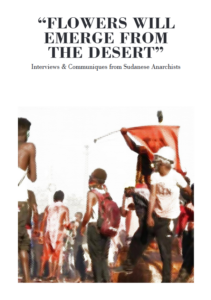
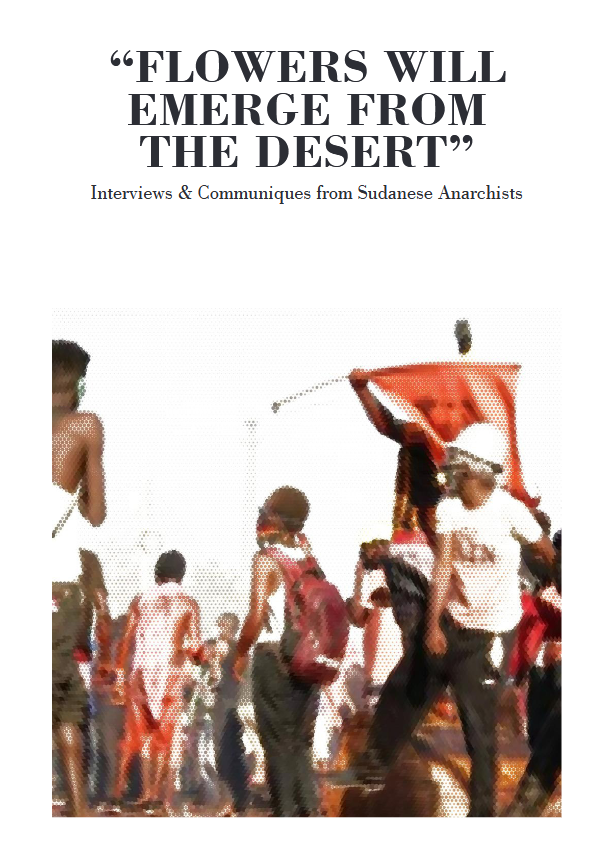
“FLOWERS WILL EMERGE FROM THE DESERT” – Interviews & Communiques from Sudanese Anarchists

Posted on 17/12/2024 - 02/01/2025 by muntjac

A collection of interviews and writings by anarchists in Sudan.

Also avalible in our shop; https://ko-fi.com/s/02d9e93e68 [Proceeds donated to the Sudanese Anarchist Gathering]

Flowers Sudan-Print Flowers Sudan Read

If you are an org or group of friends who want to put on an event to support the Sudanese Anarchist Gathering or other Sudanese people resisting war and genocide, get in touch and we can send you a box of the zine for free.

Free Association of Autonomous Fire – ACTION CLAIM FOR NIKOS ROMANOS AND SIDIQ/AND ALL THOSE WHO WERE KILLED BY COPS/BANDUNG

Posted on 14/12/2024 by muntjac

DITERIMA DARI SITUS anarchistnews org

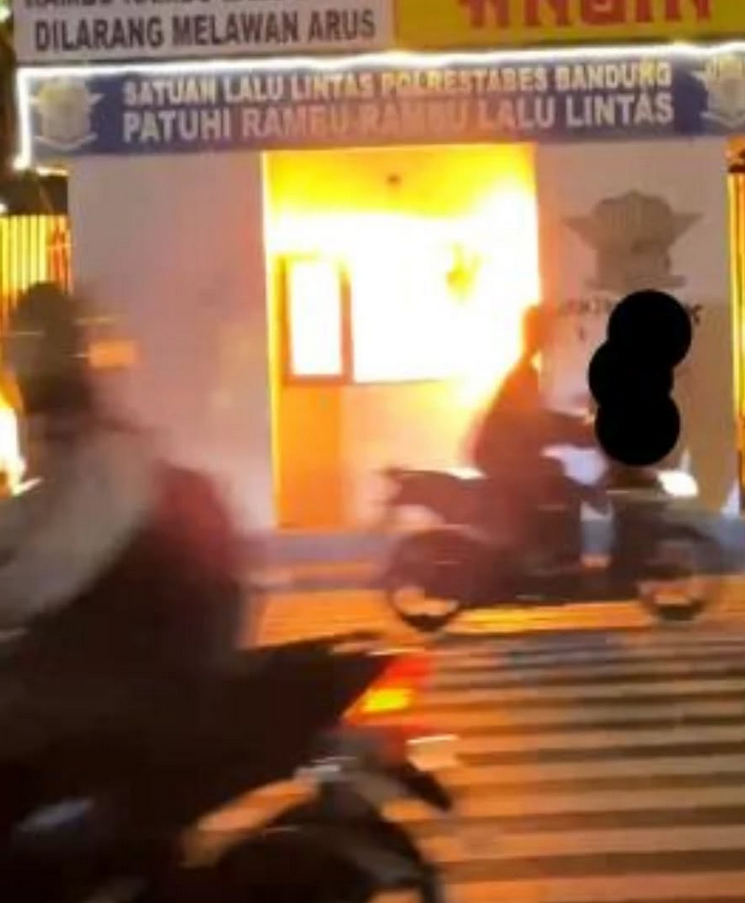
ACTION CLAIM FOR NIKOS ROMANOS AND SIDIQ/AND ALL THOSE WHO WERE KILLED BY COPS/BANDUNG

We claim that the attack and arson of a police post in Bandung, West Java on December 13, 2024 coincided with World Anti-Police Day. This attack and arson is in solidarity with our imprisoned comrade Nikos Romanos, as well as Sidiq and all imprisoned anarchists. This attack is also in solidarity with the victims of police brutality who have lost their lives all over the world and in this fascist country. Police agencies will never disintegrate on their own just like the state, they must be destroyed!

Until all are free!
Until all prisons are destroyed!
Fire on the prisons!

Free Association of Autonomous Fire

______________________________________________________

Kita mengklaim aksi penyerangan serta pembakaran terhadap pos polisi di daerah Bandung, Jawa Barat pada tanggal 13 desember 2024 bertepatan dengan hari anti polisi sedunia. Tak lupa penyerangan dan pembakaran ini adalah bentuk solidaritas untuk kawan kami Nikos Romanos yg terpenjara, juga Sidiq dan semua anarkis yg terpenjara. Penyerangan ini juga ditujukan untuk solidaritas kepada korban kebrutalan polisi yg telah memakan korban jiwa di seluruh dunia dan di negara fasis ini. Badan kepolisian tidak akan pernah hancur dengan sendirinya sama seperti negara, mereka harus dihancurkan!

Sampai semua bebas!
Sampai semua penjara hancur!
Api ke penjara!

Free Association of Autonomous Fire

poet of da soil – A 4TH WORLD INNA BABYLON

Posted on 14/12/2024 by muntjac

This peice was featured in Issue 1 of Muntjac Magazine


4TH WORLD – “Subpopulations existing in a First World country, but with the living standards of those in a third world, or developing country.” – read An introduction to the 4th World by MerriCatherine and Kiksuya Khola


(make maps out of tha ashes – tha ancestors guide us)


i can tell u what we remember:

a friend recounting how they watched riots on the news at 10 years old

asked their mum if they could go

they had a lot to be angry about

and we have a lot to be angry about

mark duggan made london, liverpool, nottingham, bristol and gloucester burn

niggas who brought babylon 2 its knees

and they remember

and they’re afraid

its why no matter what u vote these parties all hate immigrants

its why you’ll see TSG vans at every rally

and citizenship don’t mean anything when they can remove it

the easiest way 2 find out if you’re british is tha colour of your skin


babylon law codifies white civility in stone

and whoever diverges knows how cruel a state can be

council estates turned penitentiaries

mosques declared training grounds for jihadists

but when it comes 2 terror

what is terror if not august race riots and bibby stockholm

if not PREVENT harassing children

And 1 in 5 BLK mothers dying

And BLK kids are 4x more likely 2 be sexually assaulted strip searched

because NHS and Met Police aint 2 different from EDL

white supremacy coats every breath we take on dis island


but think back

think back

think back

2011 – 1985 – 2001 – 1981

every flame is purifying

1976 carnivals they made pigs scatta by chanting soweto

time 2 make pigs scatta by chanting harehills and moss side

by chanting brixton and barking

chanting peckham and palestine

tower hamlets and haiti

croydon and congo

postcolonial peoples

chanting world black revolution

and fourth world uprising


fourth world(?)

third world oppressions as a first world problem

every european country with a black underclass

babylon and that muslim underclass

Tha kweer niggas that know refuge in the crevices of the third world/swimming around tha murky banks of britan

those living and breathing in peripheries of tha belly

tha estates that be

concentration camp/holy ground/slave revolt ground zero all in one

every school in the ends a pipeline 2 prison

tha ppl called terrorist or criminal

we be fourth world – tryna end tha first world

trapped inside internal colonies

while our motherlands celebrate independence(?) days

postcolonial peoples who reject white saviours

the only gods we know are our hands

solidarity is awkward but tha yutes know it best

we be tha ones that makes devils scatta be it 2011 or 2024

tha real anti-fascists – tha trotskyists could neva

we be fourth world – tryna end tha first world

the only one we know


poet of da soil is a Black queer muslim poet and abolitionist, you can read more of their writings at substack.com/@poetwav

Ektin Ekdo – Do we want to protect each other, or just ourselves?

Posted on 14/12/2024 - 28/12/2024 by muntjac

This peice was featured in Muntjac Magazine Issue 1


Do we want to protect each other, or just ourselves?

The question comes as a comrade writes:

There has never been an anti-colonial movement in Britain from colonised people.

Uprisings, sure. Fleeting moments with little support to be found from The Movement .

“No Justice, No Peace” heard on the same streets where those in power continue to deal out injustice, in peace

Keep your head down, stay out of trouble and you’ll do well.

A lonely fascist surrounded by 200 anti-fascists, says someone unaffected by the uniformed fascists between the anti-fascists & the ‘lonely’ fascist.

“There’s security here and I don’t even know who they are!” proudly exclaimed by a community ‘anti-fascist’ organiser.

A protest steward faces a crowd of de-arresters, tells them solemnly tells them that the police won’t take anyone away

A van drives off with a minor in-tow

Instead of seeding you’ve been ceding and now there’s no land left to grow

or go to

“I abhor all violence” said only in reaction to retaliation and uprisings from below

“This will only make us look bad” say those who have more than enough power to change what looks bad

Who is us, anyway?

People who love britain, but abhor fascism? A vile contradiction at best.

Discomfort grows, alongside avoidance.

Conflict continues regardless.

In a world full of still violences, willingness and determination to distance yourself from violence won’t save you, but it’s easy and comforting to be a pacifist when violence is distant.

Community is as necessary as it is messy. Civility it is not. Militancy it contains.

There are communities beyond what is state-sanctioned or acceptable.

Will we stand on what we mean, or will we muddy things for personal gain, comfort?

If you let your enemies/adversaries or even the people you are trying to move decide or guide your tactics, then who is winning?

“What and who are you trying to save?”

If you are speaking for yourself, speak for yourself

Do not speak to condemn me for things you are unwilling to do

Do we want to protect each other, or just ourselves (and britishness, inexplicably)?


Sunwo – Against Black Britishness

Posted on 14/12/2024 - 20/12/2024 by muntjac


This peice was featured in Muntjac Magazine Issue 1


For a country partly responsible for spreading ideas like nationalism across the globe, Britishness is not just a badge—it is a mechanism of control. To be “black” in Britain, then, should be a negation of coloniality. Yet, the lack of continuity in the decolonial struggle within the heart of the colonial core has created a form of cultural amnesia. Our people’s came here seeking liberation from the chains of colonialism, dreaming of a better life. But in doing so, they were forced into a new form of intercolonialism. Now, we wrestle with the impossible task of fitting into a culture that negates our very existence and liberation.

What does it mean to be captured, to be colonised inside the heart of the empire?

Black people in Britain experience systemic oppression at every level. We are the least employed, the least paid, and we hold the least significant positions of power. The rare exceptions, the tokens, have climbed up by bootlicking their way in to the system. We are disproportionately incarcerated, and when sentenced, we face harsher punishments for the same crimes committed by our white counterparts. The system is designed to push us into poverty and then criminalises us for it.

The healthcare system, too, reflects this systemic neglect. We experience the worst health outcomes and receive the poorest treatments. Our communities are ravaged by a combination of structural inequality and outright hostility. And yet, many of us cling to the dream of “success” within this system—a dream that ultimately requires us to work for the very state that oppresses us. Success in this system, for Black people, can only mean subjugation.

The Lessons of Windrush

The history of Black people on this island is a history of exploitation. Our relationship with the British state is defined by labour: we were brought here to serve the dying empire. The Windrush generation should serve as a lesson in how we are used. They came to rebuild Britain after the war, only to face hostility, deportation, and betrayal.

Today, we see the same pattern in the legally sanctioned immigration of African health and care workers. They are brought here under unequal terms, with limited rights to stay and build a life. Their purpose is clear: to prop up a crumbling system. This unequal exchange, this intercolonial migration, reflects the ongoing exploitation of Black labor to delay the collapse of British society.

Against Britishness

Black people must reject Britishness as a core identity. It should exist only as a condition for administrative purposes—a recognition of the reality we must navigate. But we cannot allow it to define us. To accept Black Britishness is to fall into the same traps as Black Americans, who have been isolated by nationalism. American Blackness, forged in the crucible of reactionary patriotism, has become complicit in imperialism. This “imperial Blackness” serves the empire rather than resisting it.

Instead, we must imagine and fight for an anarchic, liberatory Blackness. This is a Blackness that transcends borders, a Blackness that resists the conditions of oppression affecting Black people worldwide. It must be rooted in solidarity with the diaspora—connecting not just African descendants but all Black people subjected to colonial violence, from the Caribbean to the Pacific.

Toward a Liberatory Future

To build this liberatory Blackness, we must focus on radical cultural and political practices that reject assimilation into colonial systems. This means organising through autonomous horizontal formations that coordinate locally and internationally, sharing radical histories, ideas, and strategies. It means rejecting nationalism and imperialism in all forms.

Our struggle must be insurrectionary and disruptive. We must engage in direct action, mutual aid, and self-organisation. Only through resisting are we going to overcome the forces that seek to isolate and oppress us.

Anti-colonial struggle must be fought within the colonial core itself. The crimes of this country—the systemic exploitation, the racism, the xenophobia—can only be addressed through the collapse of the empire that created them. We cannot reform an empire; we must dismantle it.

For Black people in Britain, liberation cannot come through Britishness. It can only come through the rejection of empire, the rejection of borders, and the creation of a radical, borderless solidarity.

Zhachev – Please Stop Demonizing Militancy

Posted on 14/12/2024 by muntjac

This peice was featured in Muntjac Magazine, Issue 1

“The rifle has revealed itself, but the lion has not.”

— “Tallat el Baroudeh”, Palestinian folk song

The phenomenon of militancy is shrouded in controversy and misconception. Upon closer examination, the context in which militancy generates and emerges reveals a complex web of factors that contribute to its presence. The erosion of traditional ways of life, the global imposition of Western cultural values, broad economic disparity, social marginalization, and disruption of social norms can and often do all play a role in shaping the dynamics that sustain militancy. Engaging in armed struggle, militants are not only fulfilling social obligations to protect their people and preserve their culture, but they are also self-asserting a reconstituted subjectivity, a militant individuality, actualizing their unlimited potential as creative individuals, becoming unmoored from the mires of resentment, through action.

The militant individual is often one who has experienced either a strict limitation or a total denial of their individual subjectivity. This suspension can stem from a variety of sources, including: traumatic experiences, societal expectations, cultural norms, political regimes, and many more. In some cases, the sense of self of the militant is forged in opposition to historical realities and other definitive constraints, some or all of which may be imposed upon them non-consensually. This leads to deep-seated resentment and desire for resistance. The experience of external restraint can also be internalized, with individuals being socialized to conform to certain societal norms and expectations. The pressure to adhere to these norms can be overwhelming, leading to feelings of suffocation, and a desperation for change. The desire of the militant for self-affirmation, self-expression—for autopoiesis—becomes a means of reclamation, a means of asserting their desires, existence, and individuality.

In some cases, the experience of limitation can be particularly acute, like in situations where certain groups or communities are extremely marginalized and repressed. The sense of self of militant individuals might also be shaped by things like the struggle for simple recognition, or a chance at prosperity, as they seek to challenge the dominant culture and societal structures that attempt to silence and erase their voices.

The desire of the militant individual for autopoiesis and free expression is often driven by an intense sense of urgency, as they recognize that time is never in their favor in life, and that any opportunity to assert individuality is likely to be fleeting. This sense of urgency can manifest in a variety of ways, from spontaneous outbursts, to acts of civil disobedience, and even to more focused and deadly forms of violence.

Ultimately, the desire of the individual for self-expression and autopoiesis is an all-too-human desire, one that cannot ever be completely silenced or suppressed, and by extension the same can be said about militancy. It is at the barest a cry for recognition, a demand for dignity, a command to be heard and seen as an individual with potentiality and subjectivity, no matter how different or unique.

The desire of the individual for autopoiesis and self-expression, especially through armed conflict, is not only part of the personal journey and development of the militant individual, but a fundamental requirement for the survival and cohesion of the larger group. In many traditional and tribal communities, armed struggle and conflict are seen as a necessary means of maintaining and ensuring the well-being of all individual members of the community. Armed struggle serves as a way to resolve disputes, redistribute resources, and reconstitute social bonds. In many societies (especially those originating prior to the era of modern, mechanized, total war), warfare is not simply a brutal and destructive act, but rather a crucial mechanism for maintaining social harmony and equilibrium. It allows for the release of tensions and pent-up energies, and provides opportunities for individuals to distinguish themselves through bravery, skill, speed, and cunning, with those who demonstrate exceptional prowess in battle earning the favor and admiration of other individuals within their community. At times, armed struggle also serves as a way to define (or usurp) social roles and hierarchies within certain communities, by community members. Armed struggle is a means of creating shared experiences and memories which often end up binding communities together and sometimes even defining communities and their trajectories. The collective trauma and suffering inflicted during conflict can create a sense of solidarity and mutual understanding among individual members of a community, as they come together to mourn their loses and rebuild their lives. In this way, armed struggle can also be a catalyst for social cohesion, rather than only a destructive force and cycle of retribution that simply tears communities apart.

The militant individual is not merely an aberrant or deviant figure, not a “villain”, but rather an unextinguishable component of the human social fabric. The desire for autonomy and self-expression is not a personal whim, nor a simple act of spite, but instead, sometimes a necessary condition for the survival and flourishing of a people.

Zhachev


Zhachev is a 35 year-old Palestinian born in exile in the southeastern United States. He currently lives and writes from the southern Blue Ridge Mountains.  substack.com/@zhachev


Harrow Antifascists – Report back from Harrow 07.08.24

Posted on 14/12/2024 by muntjac

This article was features in Muntjac Magazine Issue 1

Around 400 anti racists came out last night in North Harrow while the fascist rioters failed to show up at their announced location. If they had shown up they wouldn’t have stood a chance.

Around 100 people joined a protest with speeches and chants called by the local TUC, PSC & Counterfire. On the other side of the junction around 300 people lined every shop in the high street as part of a community defence group put together at 2 days notice. All of the local man dem came out and stood alongside the shopkeepers. There was a very strong turnout from the local Tamil community as well as brothers from Mahfil Ali Mosque and many Hindus and Sikhs coming out in unity and the community defence stayed out long after the protest finished. Many of us planned to travel to Brentford or Hounslow if fash didn’t turn up, but they failed to show up there as well! There was a huge sense of joy among everyone there that our community had come out in such numbers and represented, and that the racist riots we’ve seen across the country weren’t happening on our patch.

The protest was mostly white and the Community defence was mostly Black and Asian but the whole community was united. Only a handful of people linked to the activist scene travelled from other parts of london to support and their support was very much appreciated. This is because most people from the scene were in areas closer to them like Finchley, Walthamstow, Stokey and Croydon, and people up for travelling north west mostly decided to go to Brentford instead where numbers were more needed. Elsewhere in Harrow over 100 brothers stood guard around Harrow Central Mosque late into the night and the fascists came nowhere near.

Unable to have a mob riot the local fash have resorted to tactics they’re describing as “guerrilla warfare”. Reports have been coming in the past few days of a liquid being thown on a hijabi women by a white man which may have been acid, cars of white people driving round shouting racist abuse and death threats at POC, bottles thrown over the fence of a school holding a summer camp and a white van driving around Wembley with a man throwing acid at Muslim women, white men in balaclavas being arrested by police in Harrow on their way to riot and an Indian student fatally stabbed in a possible racist attack. The school has been contacted and confirmed there was an incident, other reports such as fighting in Wealdstone are unconfirmed and can fly around at these times but we know what is taking place.

Aside from a handful of potential spotters and livestreamers too frightened to film, a Hindutva fascist and confused desi Tommy Robinson supporter called Tirbhuwan Chauhan showed up, and a lone polish fascist started shouting racist abuse in the middle of the crowed and stamped on the foot of a man with his leg in a cast before the fascist was rescued by police. But instead of arresting him the police guarded him in numbers before bundling him away into a getaway car. Another car drove past and a racist punched a protester out the car window before speeding off but the police did nothing about this. Instead the police decided to focus on trying to enforce the section 60 they’d put in place and harass anti racists into removing their face coverings. The police couldn’t get their heads around the fact that the section of society they’re so used to criminalising and stereotyping were the ones who were out to protect our community and prevent a riot. However people looked out for each other and refused to remove our face coverings and despite threats, the police failed to arrest any anti-racists or enforce the section 60.

Violent riots nationwide, co ordinated racist attacks by lone individuals and small groups  and arson attacks on homes aimed at massacring or expelling ethnic and religious minority groups is the definition of a pogrom. The anger of the racists has been stirred up by the lies of the media, influencers and politicians from New Labour, the tories and the far right, looking to scapegoat and distract from the oppression of the entire working class by our ruling elite. If Keir Starmer now goes ahead with his planned sweep of mass immigration raids then he will be rewarding the racist rioters, showing them their actions lead to results, and ordering the mechanisms of the state to take part in the pogrom and expulsion of the most oppressed and targeted section of our society. For now our mass community resistance nationwide may have halted the riots but we may need to utilise our networks and come out with the same strength to stop the colonial racist state from launching deportations and carrying on the pogrom of the racist rioters.

This was written by a member of Harrow Antifascists, a community based anti fascist network which helped organise the local defence group who came out on in anticipation for attacks by fascists. This was first published on the Inquilab blog.

Simoun Magsalin – Notes towards a Decolonial Anarchism for those Neither Indigenous nor Settler

Posted on 14/12/2024 - 14/12/2024 by muntjac

This essay was featured in issue 1 of Muntjac Magazine

In the archipelago so-called as the “Philippines,” the anarchism of the older milieu characterize their anarchism in terms of indigeneity and decoloniality. This milieu, represented by their foremost theorist Bas Umali, appropriate indigeneity and combine it with primitivism and deep ecology. As Umali says,

> Decolonial processes do not tell you to adopt indigenous culture, but they do not stop you from doing so either. The most essential in this process is awareness. If someone takes action it should be their decision. (*Pangayaw and Decolonizing Resistance*, 2020)

As such, this milieu believes that they are entitled to Indigenous culture by virtue of having descended from indigenous ancestors. This is not without controversy. A comrade of mine criticizes this line of thinking saying that this appropriation of indigeneity is unjust, especially given that Umali’s book profited off Indigenous culture without bringing it back to Indigenous communities. In this I agree, but what was more thought-provoking was how they initially characterized Bas Umali as a settler.

Now wait a minute, Bas Umali, like myself and many others, are Manileño, that is, we live in Metro Manila. The Philippines *does* have settler colonies in many places in Mindanao and the Cordilleras, but Manila *itself* has no Indigenous people on its land. Or perhaps to say it in another way, the indigenous peoples of what would become Manila were systematically colonized and have become alienated from their relationship to the land. Indigeneity is first and foremost a social relationship to land and colonization. Indigenous peoples continue to exist in the Philippines, and they exist in relation to colonization by Filipinos. But what are most Filipinos if we’re neither Indigenous nor settler? Clumsy importation of American terminology cannot do for our purposes.

Let’s start with the low-hanging fruit: Who in the Philippines are Indigenous and who are settlers? Perhaps more than fourteen million Indigenous peoples live in the Philippines subdivided into more than a hundred languages. Many of these Indigenous peoples live on their ancestral domains, have a connection to their land, and are actively still threatened by continuing colonization that threatens their lives, cultures, and lands. Many of these Indigenous peoples live alongside Filipino (Christian) settlers from elsewhere in the country. These settlers may perhaps be Ilocanos and Tagalogs gentrifying Baguio and its environs, or perhaps Ilonggo or Visayan settlers in Mindanao. These settlers are unambiguously settler-colonial, their settlement as a project of state-building to settle “Christian” Filipinos across unruly and untamed frontiers by the Spanish, American, and later post-colonial state apparatuses. Settler colonialism also played a part in defeating the first communist insurgency: rebels were offered free land to settle in Mindanao where they became the shock troops for genocide and state-building, especially against Moro (Muslim) and Lumad (neither Christian nor Muslim) peoples and tribes.

With those who have clear positions social relations of Indigeneity and settler colonialism, identifying settlers and Indigenous communities are somewhat clear. But what about me and many other Filipinos whose ancestors *were* indigenous but have become Christianized and colonized?

I posit that most of us so-called Filipinos are post-colonized subjects, specifically *post-colonized creoles*. We bear the trauma of colonization in our collective memory and even in our mixed blood. We are not wholesale colonizers like White people, but we are not Indigenous either. Although this does not mean that post-colonized creoles do not have the capacity to *become* settlers—we absolutely can when we enter in a colonizing social relation with Indigenous peoples such as being settlers in Indigenous land like with Christian settlers in Mindanao or in the Cordilleras. But the point is that we are also not colonized to the same extent as Indigenous communities. In places such as Metro Manila where there are no Indigenous communities, however, we cannot characterize ourselves as settlers without being in relation to Indigenous communities.

As post-colonized creoles, we cannot posit Indigenous anarchisms. By extension, Bas Umali cannot posit an Indigenous anarchism by virtue of a colonized ancestry. While his concept of *pangayaw* is rooted in Indigeneity, my comrade noted Bas Umali is still divorced from an Indigenous context and takes *pangayaw* from Indigenous cultures without giving back to Indigenous communities. (This, however, does not invalidate the value that Indigenous anarchists such as those in the Indigenous Anarchist Federation (IAF-FAI) find in Umali’s work.)

So then, what does it mean to be a post-colonized subject? What does it mean to be creole? What does anarchy look like in a post-colonial/creole context? What are the prospects of decolonization for the post-colonized creole? More than just a critique of Bas Umali’s appropriated indigeneity, these questions have serious implications for anarchism in the post-colonized and underdeveloped world, particularly for the so-called Philippines and Southeast Asia.

When in contact with Indigenous communities, creoles become settler colonists. In this sense, the ideas of decolonization as land-back is quite applicable. Decolonization in this regard is the creole respect of Indigenous lands, the cessation of colonial logic on Indigenous peoples and their lands, and recognizing Indigenous stewardship.

But outside these settler-colonial zones, what is creole decolonization? Historically speaking, creole decolonization was the transfer of sovereignty from a colonial overlord to a creole state. In the Philippines, this creole decolonization manifested when the United States of America formally gave the Philippines its autonomy and later independence. As anarchists and abolitionists, however, we recognize that the new creole state continued to reproduce many colonial institutions and features: the centralized state apparatus, the police, the prisons, the settler-colonies, the plantation logic.

Before colonization the state and its appendages simply did not exist. Creole decolonization was merely the replacement of a colonizer head with a creole head, all institutions of colonization still in place.

The project of decolonization is woefully incomplete as long as the state apparatus, creole settler-colonialism, and other colonizing patterns continues to exist. The archipelago so-called as the Philippines is not “decolonized” by virtue of having Filipinos in charge of the state— especially if we see colonization as an explicit process of state-building. In this sense, decolonization for the creoles of Metro Manila is the *undoing* of the state, *undoing* of wage-labor, the *undoing* of the police and prisons. Colonization imposed these things upon us, so decolonization means the doing away of these things. This does not mean that decolonization is the return to an Eden before colonization, which is impossible. We can never go back. Rather, decolonization is the recognition that the structures instituted by colonization are not permanent or inevitable features of society and thus struggle for a way out.

The national democrats and other leftists in the country still misunderstand what decolonization is—the undoing of what colonization did to us. They still want “national democracy,” therefore a state, police, prisons, wage-labor, all things instituted by colonization. They argue for “national liberation” of a Maoist type where the imperialists and their compradors are kicked out and a national-democratic state oversees national industrialization, with nationalized industry, wage-labor, police, prisons… Decolonization is not this or that group in charge of the state and capital.

But neither is decolonization for post-colonial creoles the appropriation of Indigeneity. Of course we need to reinstate our relationship and connection to the land and bring land-back for those who are Indigenous. Nor is decolonization *merely* our current society but without the state, wage-labor, police, prisons, et cetera, but keeping in place the anti-ecological political-economic extractivist apparatus and ways of living.

Nor is decolonization a vulgar romantic primitivism or localism. As creoles, our blood not only contains the marking of trauma, but also of cosmopolitanism. We have roots from China, America, Ilocos, Cagayan, Cebu, Zamboanga, and Manila. Decolonization in the context of this cosmopolitanism would also mean the reaffirmation of *interconnection*, especially as a hybridity liberated from the insular enclosure of borders and the nation-state system.

It is here that we can then sketch what a decolonial anarchism is for post-colonial creoles: not just the land-bank for Indigenous communities, but also liberation from the structures and institutions that colonialism has put in place and all that entails. Specifically for the Philippines and Southeast Asia, decolonial anarchism means restoring the cosmopolitanism of the sea-routes and opening the national enclosures.

Importantly, we do decolonial anarchy *as creoles* and *as post-colonized subjects*, not appropriative of Indigeneity. Our creolized cultures may have the traumatic scars of colonialism and Christianization, but it is not something *merely* the product of colonial state-building. It is also reflective of a cosmopolitan past as the gateway to China and the Americas and a resiliency of spirit that persists despite the weight of Empire upon it.

Anarchism and anarchy may have its roots in the European and Atlantic proletarian milieu, but it has walked around the world even before Lenin did. Creoles like José Rizal, Isabelo de los Reyes and Lope Santos engaged with and took bits and pieces from anarchism to inform their militancy against colonial authorities. Like how creolized colonial populations would indigenize Christianity, anarchism was similarly indigenized and creolized. Rizal would take point from the Proudhonist tradition, de los Reyes and Santos would take point from Malatesta (and Marx). Decolonial anarchism in the Philippines would mean continuing the indigenization and creolization of anarchism.

Furthermore, creolized colonial populations would practice marronage to leave the colony to create rebel peripheries free from the state. One such act of rebel marronage with the Dagohoy rebellion founded creole communities in the boondocks of Bohol that lived free from the Spanish colonial state for 75 years. Even the Maoists continue this tradition of marronage with their own rebel peripheries, though they are not without problems as they want “national democracy” with their own state.

However, sketching this decolonial anarchy on our own creole post-coloniality is not the same thing as Maoism’s and national democracy’s nationalism and desire for a national state. While we cannot, of course, dismiss nationalism out of hand, given nationalist decolonial struggles for common and communal dignity, we cannot also dismiss how leftists use it to justify right-opportunism with the ranks of the ruling class on the basis of nationalism against imperialism. This is how national democracy acted as the left wing of the Rodrigo Duterte’s fascism. Decolonial anarchism can and should be specific to context, but it must not be dazed by parochial illusions.

Decolonization for those neither Indigenous and settler in the Philippines, then, is an anarchy that is specific to our nature. It is one that is cognizant of our history and post-coloniality, one that moves beyond the nation-state system and restores the cosmopolitanism and hybridity and overcomes the parochialism of the nation. Decolonial anarchism is one indigenized and creolized to fit the specific circumstance and context of the people. Decolonial anarchy is one that works hand-in-hand for land-back for those with homelands and ancestral domains, and one that restores our relationship with the land without succumbing to appropriation.

But decolonial anarchism and anarchy is still a project in flux, not just in the Philippines, but across Southeast Asia and the global south. These notes are only one part in the continuing conversation on its indigenization and creolization.

 

Posts navigation

Older posts

"Anarchists know that a long period of education must precede any great fundamental change in society, hence they do not believe in vote-begging, nor political campaigns, but rather in the development of self-thinking individuals."

Lucy Parsons - The Principles Of Anarchism, 1905

Contact us
fawnarchy@grrlz.net
(Signal) muntjac161.96

"Social" Media

Monthly Newsletter (Via Email)

Buy The Magazine / Donate / Subscribe

Send Us Stuff!
We adore books, zines, love letters, posters, and sweet treats.
But please contact us first...

Muntjac Collective
C/O Freedom Press
84b Whitechapel High St
E1 7QX
London
UK

Protect Yourself
AnarSec
No Trace Project
Tor Project
Tails USB

Counter-Info
Act For Freedom Now!
Unoffensive Animal
Unravel
Sans Nom
Switch off! - The System of Destruction
Squat Radar
A2day
Insendier!
Contra Info
Blessed Is The Flame
Avtonom
La Nemesi
Takku
Informativo Anarquista

Police Monitoring
Copwatch Network
NetPol

Stop Deportations
Anti Raids Network
Migrants' Rights Network

Anti Repression Projects
Bristol Anarchist Black Cross
Brighton Anarchist Black Cross
Incarcerated Workers Organising Committee
Palestine Action Prisoners
Lavender Pages (a solidarity project for LGBTQIA+ prisoners)
NYC Anarchist Black Cross
Support Defendants & Prisoners From the George Floyd Uprisings
Prisoner Solidarity
June 11th - International Day of Solidarity with Marius Mason & All Long-Term Anarchist Prisoners
International Week of Solidarity with Anarchist Prisoners // 23 – 30 August

All our publications are free for prisoners.

  • November 2025
  • June 2025
  • May 2025
  • April 2025
  • March 2025
  • February 2025
  • January 2025
  • December 2024
  • November 2024
  • October 2024
  • September 2024
Proudly powered by WordPress | Theme: micro, developed by DevriX.